
Bullying Is Forever
Posted: March 15, 2013 Filed under: Uncategorized | Tags: bullying, bullying effects, bullying research, bystanders, school climate 3 Comments
Student poster from H.W. Perkins, D.W. Craig, & J. M. Perkins, “Using social norms to reduce bullying: A research intervention among adolescents in five middle schools,” Group Processes & Intergroup Relations (2011), 14(5), 703-722.
Note: This is the first of several posts about bullying.
Bullying, that age-old enemy, is making headlines again, and the news isn’t good: Its nasty effects last. These reports back up our intuitions with hard research evidence for the very first time.
Hard evidence
- A 20-year-long study, the most comprehensive to date, found that children wear the scars of bullying far into their adult lives. Kids who use bullying behavior have a high risk of antisocial personality disorder; those who are bullied are very prone to depression and anxiety; and “bully-victims,” who bully as well as being bullied, carry an even higher risk for anxiety and depressive disorders and suicidal thinking. The findings surprised lead researcher William E. Copeland of Duke University Medical Center, who calls these effects “as potent as the effects of abuse.”
- Boys who frequently bully their classmates are four times more likely to behave violently with their women partners when they become adults.
- Being bullied changes a child’s physiological response to stress, affecting the genes involved in regulating mood and depression and rendering targets more vulnerable to future stress and psychopathology.
- Many children who are bullied develop persistent clinical symptoms of post-traumatic stress disorder (PTSD). Bully-victims have even higher levels.
Can we stop bullying?
Research is booming, but have we learned how to prevent and stop bullying? Do we have any tools that work?
Bullying is an incredibly complex phenomenon, made even more complex since cyberbullying entered the picture. It has become increasingly apparent that there is no quick fix. Strategies such as zero tolerance, technology bans, and heavy punishment don’t work, and some programs that looked effective initially haven’t lived up to their promise.
But elements of some existing interventions have proven worth keeping, and new approaches are emerging.
School climate is key
When it comes to bullying, a lot depends on school climate, so anti-bullying efforts should involve the whole school as well as parents and the community. In schools with a positive climate, there is less bullying and students are more likely to report incidents to a trusted adult.
A positive school climate looks like this:
- Students feel safe, connected, and supported
- Students and teachers treat one another and their peers respectfully and fairly
- There are clear rules against bullying, and students trust that the adults in their lives will immediately, appropriately, and consistently intervene to stop it
- Social and emotional learning is included in the curriculum
- People value diversity and inclusion—because children who bully often choose targets who are different in some way
A school survey to identify bullying hot spots, a system for anonymous reporting, and close supervision of public spaces such as bathrooms, corridors, and playgrounds bolster safety and security.
Bystanders play an essential role
It is vital that students, teachers, and parents understand what bullying is and what they can do about it. Even the traditional definition—when a person with more power intentionally and repeatedly harms a weaker person—is currently stirring up controversy among experts and legislators and requires thorough discussion in class and at home.
Bullying is a group activity, with bystanders involved 85 percent of the time. Their assistance, comments, laughter, and even their inaction show that they condone and approve of bullying—and actually increase it.
Fortunately, about 20 percent of bystanders defend a child who’s targeted, and 57 percent of the time their efforts are successful within 10 seconds. Paradoxically, 80 to 85 percent of students say they admire the defenders and disapprove of bullying. But they don’t act on their beliefs.
Because children who bully successfully are powerful and popular (whether they are liked or not), bystanders bow to peer pressure and don’t speak up. But researchers believe that this same peer pressure can actually change bystander behavior.
In one study, schools surveyed student views on bullying and created posters that reflected the data, which confirmed that most students disapproved of bullying. The result? Bullying dropped by as much as 35 percent.
Another study demonstrated that even students with low social status—who are usually the least willing to intervene—will step in when they believe their classmates expect it of them.
While we wait
School climate obviously affects peer norms and behavior, and visa versa. While we wait for more research news, we can start focusing on creating a sense of community where all children feel they belong and have a contribution to make.
Next in the bullying series: Understanding bullying and how to intervene when it occurs
School Shootings and Small Children: Turn Off the TV
Posted: December 15, 2012 Filed under: Uncategorized | Tags: school shootings, violent media 2 CommentsThis time the school shooting is in Newtown, CT, and most of the victims are children.
Horrified and upset, we stay glued to the news, grieving with the families and worrying about the safety of our own children. In the process we forget that they may be listening and watching, too.
We’re not bad people, we’re just concerned, but it’s important for us to remember that the news and young children don’t mix. The information and images are too frightening, too hard for them to process.
So let’s turn off our televisions and radios, our computers and cell phones, and try to put ourselves back together. Then we can focus on the children in our lives who depend on us to make them feel safe.
They have probably heard about this shooting or are at least aware that something terrible has happened. Let them ask questions and express their thoughts and fears. If we don’t allow them to do this, they get the message that we’re too scared to deal with the situation and they become even more frightened.
To find out what they know, ask open-ended questions and base your response on what they say. Let them know that it’s natural to be afraid and you’ll do everything you can to keep them safe.
Above all, spend time with them, listening, talking, reading, cuddling, and telling them that you love them.
For a helpful post on more we can do, see “Talking with Children about the Connecticut School Shooting” by Eileen Kennedy-Moore.
Anxiety: A Signal of Challenging Behavior
Posted: November 28, 2012 Filed under: Uncategorized | Tags: aggression, anxiety, autism, body language, challenging behavior in children, children exposed to violence, relationship 1 CommentChallenging and aggressive behavior often seems to come out of nowhere, but the truth is that if you look carefully you can see it on the horizon–in the guise of anxiety.

Anxiety in a child is a kind of early warning system that something is amiss, whether it’s the result of being left out of a group, stress at home, exposure to violence, even autistic spectrum disorder.
It’s hard to notice in a busy classroom because it’s internal; it doesn’t usually show much, and it doesn’t affect anyone but the child himself. But anxiety interferes with a child’s ability to learn and interact with his peers, and it can easily escalate to agitation and aggression if it isn’t addressed. We will certainly notice it then.
Become Sherlock Holmes
To see anxiety, you have to become a detective. To begin with, you must build a close relationship with every child and get to know all the children well–their temperaments, developmental levels, play skills, families, and cultures; what frustrates and frightens them; what makes them happy, mad, or sad.
You also have to learn to read the subtle physiological and behavioral clues the children display as they try to cope with their anxiety. For example:
- Physiology. Tears, frequent urination, clenched teeth, blushing, pallor, rigidity, rapid breathing, sweating, fidgeting, vomiting, squeaky voice
- Behavior. Downcast eyes, withdrawing, hair twirling, thumb-sucking, sucking hair or clothes, biting fingernails, hoarding, clinging, whining, being noisy or quiet, screaming, masturbating, smirking, giggling, crying
Figuring out what the child is thinking and feeling will help, too.
- Thoughts. No one loves me; no one wants me; I’m no good; I don’t like it here; I don’t have any friends; no one will come to get me; I can’t do it; I’m bad; I want my mommy
- Feelings. Distressed, troubled, afraid, nervous, excited, expectant, sad, irritable, grouchy, mad, insecure, frustrated, worried, confused, panicky
Reach Out
When a child’s characteristic clues appear, it’s time to connect–to smile, to sit nearby, to offer your help, to ask open-ended questions.
Pay special attention to your body language, facial expression, and tone of voice, which all convey far more than your words. You’ll want to do whatever works for a particular child.
This tiny intervention delivered at just the right moment will save you tons of time and trouble later, and protect the child from learning that challenging behavior is the best way to solve problems.
PS. Many of these ideas come from the WEVAS program created by Neil Butchard and Robert Spencler. For more information go to www.wevas.net
Fighting Violence with Early Childhood Education
Posted: September 24, 2012 Filed under: Uncategorized | Tags: aggression, challenging behavior, crime prevention, early childhood education, relationship, risk factors, school shootings, social and emotional skills, violence 6 CommentsThis summer two horrific mass shootings shocked the country.
The first, in July, took place at the midnight opening of “The Dark Knight Rises” in Aurora, CO, just down the road from Littleton, a town that’s still reeling from the Columbine massacre. The shooter, James Holmes, killed 12 and wounded 58.
The second attack, by an unrelated assailant, Wade M. Page, occurred in August at the Sikh Temple of Wisconsin, near Milwaukee. Six died and three were injured.
This fall, two school shooters joined this nefarious company. A 15-year-old was charged with assault and attempted murder in Perry Hall, MD; and a 14-year-old shot into the ceiling of a packed classroom in Normal, IL. Thankfully, no one was hurt.
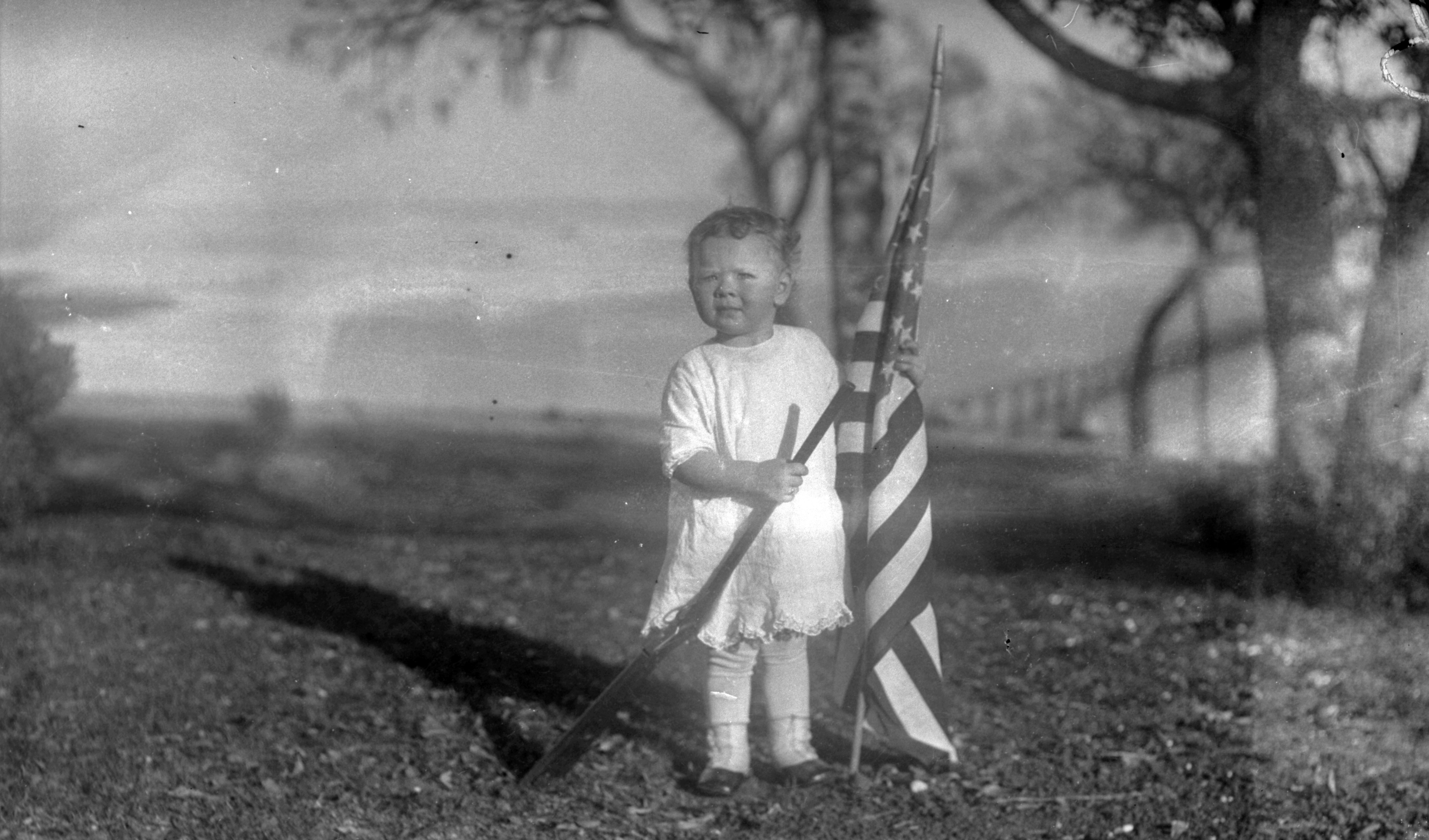
A child with an American flag and a gun in Texas in the 1920s. Photo by Harry Walker, courtesy of Special Collections, University of Houston Libraries. UH Digital Library
Risk Factors
We know very little about these shooters, and we certainly don’t know what caused these attacks. But we do know some of the factors that increase the risk of violent and aggressive behavior, and we also know that risk factors are cumulative—one plus one equals more than two. They can easily become overwhelming.
In young children, these risks work to produce challenging behavior, and when that behavior continues into kindergarten and beyond it becomes harder and harder to change.
Children with behavior problems are frequently rejected by their peers, and as a result they’re deprived of opportunities to develop and practice the social and emotional skills they need for self-esteem and success.
Their behavior also creates problems in school, where teachers all too often make the situation worse by teaching them less and punishing them more.
No wonder children with challenging behavior develop into teens who drop out of school and turn to delinquency, gangs, drugs, and mental illness. As adults they’re more likely to commit violent crimes.
White Power
Even knowing nothing about his childhood, we can guess about how risk factors led one of these shooters down a dangerous path. The Milwaukee gunman was immersed in the neo-Nazi culture of racial hatred and its white-power music, “hatecore.” The songs he played on his guitar and bass were intended to incite violence and strengthen commitment to his cause.
To heighten the risk, he—and all of the other assailants, including the teens—had ready access to guns.
A Different Life?
But maybe once upon a time they were young children with challenging behavior. If they’d had strong relationships with their teachers and effective teaching, they might have turned out differently.
The police are lobbying for high quality early childhood education because research shows that it prevents crime.
What do you think? What causes violent behavior? Is it guns? Violent media? Poverty? Genes? And what can we do about it? Can high quality early childhood education prevent crime and violence?
Welcome to Children with Challenging Behavior
Posted: March 27, 2012 Filed under: Uncategorized | Tags: aggression, challenging behavior, challenging behavior in children, violence 2 Comments
As the authors of Challenging Behavior in Young Children, we’re always looking for new information on this subject that’s so near and dear to our hearts.
From her base in Nova Scotia, Barbara travels the world giving workshops and presentations, while Judy stays home in Montreal reading books and online materials—and both of us collect interesting and useful research, ideas, and opinions that we believe will interest you, too.
So we want to share some of our discoveries.
Most of the information we find is straightforward and reliable, some of it is controversial, and some is downright wrong. We’ll tell you what we think—but we also want to know what you think, what you disagree with, what you want to understand better, what you’d like to know more about. That is, we rely on you to help us.
If we don’t know the answers to your questions, we’ll try to find out, because something that makes you wonder probably makes others wonder as well, and the more that we know about children and their challenging behavior, the more likely we are to make a difference in their lives.
We’ll focus mainly on young children’s behavior, but we’ll also write about aggression and violence in older children and adults—such as the shooting in Aurora, CO—because what happens in early childhood has such a huge influence on what happens later.
Look for us in this spot… or sign up at the right to receive an email notice each time we post.



 Children with Challenging Behavior